Sunday, October 2, 2016

What is Multisport?


What is Multisport?
The name alone sounds exhausting.  Anyone who has participated in different sports during childhood, probably had flashbacks of grueling practices or the multiple game/races all in one day.  True, multisport is generally a difficult athletic event that usually requires similar dedication as the aforementioned childhood sporting events, but it is so much more than that.
Multisport are endurance races or events that consist of different stages of aerobic activity.  Generally speaking these stages are in the form of different athletic disciplines that require a racer to be proficient in multiple events.  Probably one of the most well-known and practiced multisport event is the triathlon.  The triathlon is an endurance race that entails a swimming portion, a cycling portion, and a running portion where a continuous time of all three is combined for a time total.  Triathlon is not the only multisport however.  Other events are the duathlon, biathlon, decathlon and even adventure races or obstacle courses.  
Now, some of those races and events are very popular, but others may just seem like Greek words.  The one thing that they all have in common is that they are long, difficult, and test the endurance of not just the body, but also the mind.  It would seem that these races might not be that popular due to these traits, but according to USA Triathlon, triathlon participation in the United States is at an all-time high, following unprecedented growth over the past decade1.  In addition, an article posted by an Active writer reported that non-traditional endurance events saw a dramatic increase in participation during a four year period, whereas traditional endurance events, the marathon and half-marathon specifically, saw only modest increases in participation during the same four years2.  This goes to show that many people are beginning to participate in more multisport events and not just the typical endurance event that only tests an individual in one athletic modality.
However, with the growing popularity of multisport there comes an increased chance of  non-experienced athletes joining these events.  This is not a bad thing, but it could increase the likelihood that these athletes do not know how to correctly train in an intelligent and injury free manner.  This is where strength and conditioning professionals come into play.


References:
  1. About Multisport. (n.d.). Retrieved September 18, 2016, from https://www.teamusa.org/usa-triathlon/about/multisport
  2. Schuckies, B. E. (n.d.). The Rise of Obstacle Course Races. Retrieved September 18, 2016, from v chttp://www.active.com/running/articles/the-rise-of-obstacle-course-races mk

Modalites and Therapy You May Not Know

My name is Kyle Magyar I am currently a graduate student at Tarleton State University with plans to graduate in 2018 with my Masters of Science in Kinesiology. During my undergraduate I had the pleasure of being on the Sports Medicine team, and being able to work with all the athletes. During this time I was training to become an Athletic Trainer with the hopes of holding a career in the MLB. I did constant research on how to better rehabilitate athletes in the shortest and most efficient way possible. I was able use all different types of modalities and techniques that most people do not have access too unless prescribed by a physician. I believe if there is a way for the general population to stay healthier and active we should always strive for that. This will be what my future blogs will pertain to, the use of modalities or techniques that can help heal the body.

    These modalities are ones that I have either done research over or personally use. I believe that hands-on opinion can help influence some interest on getting better. Some who read this and try it for themselves may come to realize it is not for them, however there is always one thing that fits someone’s lifestyle that can also benefit them. Some of these I am excited and hope to get to try as well some day, these techniques I have studied have been dated back centuries and found all over the globe. The most important thing however is knowing the benefits of the treatment and what it is doing to the individual's body. This is what the blog will consist of as well, enlightening my audience as the the information of the techniques and modalities.

Gym Myth Buster


By now, most people in America are fully aware of the reality that obesity in adults, as well as our children, is a major concern. Approximately 1 in 3 adults is obese, and 1 in 7 high school students are as well.1 Most of us are also aware of many of the diseases associated with obesity.

... dumbbells_adjusted | by ...
Photo Credit: https://www.flickr.com/photos/
It’s easy to look at the statistics and come to the conclusion that many Americans are simply lazy. It’s easy to assume that we live in an era that is controlled by video games, iPads, and mobile devices, and that people these days just stay inside. I get it, for generations Americans have put their minds together to come up with ways to make tasks easier. As a result, life in 2016 is in many ways, easier than it was 50 years ago.

However, I am convinced that people ARE trying. I do not buy into the ever so popular idea that my generation and future generations are just people living off the hard work of those who came before us. I believe we are just as hard working and driven as we’ve ever been. The 20-30 billion dollars that Americans spend annually on weight loss plans, gym memberships, and supplements, are proof that we are desperately trying to get a grip on our health and wellbeing.2

With the awareness that now exists, along with the money that we spend in an attempt to get to a healthier place, why is it that we have not turned the obesity trends around? My belief is simply that as a country we are still very uneducated when it comes to nutrition, and how to workout properly. That lack of education combined with the fact that at every turn there is someone trying to capitalize, and make a buck off of us, because they know we are desperate, is the reason for this blog. Throughout this series I will shed some light on several myths within the industry, with the hope that my knowledge and experience will help someone get on the right track to achieving their fitness goals, and maybe even save some money.


1. Jaaskelainen, L. (2016). Topic: Health & Fitness Clubs. Retrieved September 15, 2016, from https://www.statista.com/topics/1141/health-and-fitness-clubs/


2. Segal, L. M., MA, Rayburn, J., MPH & MArtin, A., MPH. (n.d.). Obesity Rates & Trends. Retrieved September 15, 2016, from http://stateofobesity.org/rates/

Cryotherapy


The use of therapeutic modalities in athletic training is very popular. What’s even more well-known is the use of ice bags for anything and everything. No matter what sporting event you go to, more than likely you will see multiple athletes with ice bags. Why is that? Are they really hurt or is it something that athletes ‘just do’? Well in order to clear up the misconception of the usage of ice, let’s first explain what cryotherapy is and how it really works. One of the most common modalities to use, in my opinion, is in fact cryotherapy. Cryotherapy means “cold therapy”1 and is used for multiple reasons. There are also many types of cryotherapy to choose from including ice bags (for immediate care), cryokinetics (when you alternate cold with active exercise), cryostretch (when you alternate cold with stretching), cold tubs, ice massage and several others. There are also several reason as to why athletes use cryotherapy. “Ice reduces tissue temperature, blood flow, pain, and metabolism”.2 This is why ice is the 'go-to' option for an immediate injury. When an athlete suffers an acute injury, instant structural changes begin to take place. “Understanding the difference between preventing or limiting swelling and removing it after it has occurred”1 is crucial in knowing how and when to treat a patient with ice. When applying ice, we are trying to limit the amount of swelling at the site, not get rid of the inflammation process completely. This process is important because it is responsible for removing debris (damaged tissue) so that there is room for the new cells to come in and replace the impaired ones. You are not trying to eliminate the inflammation process but instead limit the secondary metabolic injury. By doing this, there will be less edema after the initial phase of healing.
While cryotherapy has many advantages, there is little evidence on how ice can affect tissue repair long term. “Inappropriate use of cryotherapy can cause excessive pain and tissue damage.”1 There are several contraindications to be aware of when using cold therapy such as the duration of the therapy (which could potentially cause a freezer burn if kept on too long), applying cryotherapy that is too cold, and applying it with excessive compression. Knowing how and when to apply cryotherapy can be crucial for an athlete’s injury.

Sources:
1Hubbard, T. J., & Denegar, C. R. (2004). Does Cryotherapy Improve Outcomes With Soft Tissue Injury?. Journal Of Athletic Training (National Athletic Trainers' Association), 39(3), 278-279.
2Knight, K. L., & Draper, D. O. (2008). Therapeutic modalities: The art and the science. Baltimore, MD: Lippincott Williams & Wilkins.
By a spin of a dial and a push of a button, patients will receive premium treatment. (n.d.). Game Ready Ice Machine. Retrieved September 22, 2016, http://www.shop-orthopedics.com/Game_Ready_Ice_Machine_p/550500-03.htm
By Research? ~ Eat. Run. Rehabilitate. (n.d.). When Is Cryotherapy/Ice Supported By Research? Retrieved September 22, 2016, from http://www.eatrunrehabilitate.com/2015/02/when-is-cryotherapyice-supported-by.html


After School Programs


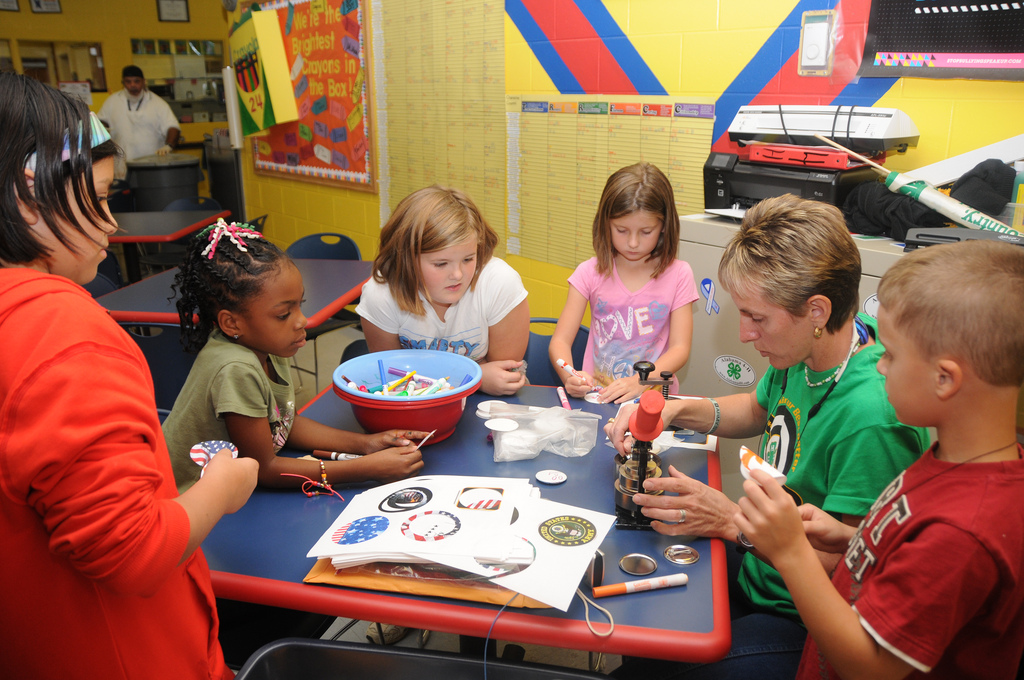
After school programs, or ASP’s, help provide safety and supervision to adolescents while still letting them expand their cognitive, physical, and social skills with fellow classmates and other children in the community. After school programs offer a wide variety of activities to the attendees. Some activities include, but are not limited to, assistance with homework, craft day, cooking/nutrition day, and fitness.
When a child is in an afterschool program they are surrounded by mentors who are there to deter the child from negative activity. “Juvenile crime and victimization peaks in the hours after school, yet 1 in 5 kids are left on their own during these hours.”1Adolescents who are left alone in those couple of hours after school and before mom and dad return home are more prone to wander out and experiment with negative things such as drugs, alcohol, and destructive behavior. “For every dollar invested in afterschool programs, $2.50 is saved in crime-related costs.”1
asp.jpg
photo credit: americandragononline.com/afterschool
After school programs are the prime time in the child’s life to start introducing a healthy lifestyle.1 The majority of the children who attend are “at the developmental stage when they are forming the health patterns they will carry into adulthood.”2 The hours of a majority of after school programs are from 3-6pm. That is three hours between school and before dinner time. Most, if not all, ASP’s will have a brief twenty(ish) minute snack time, the mentors can take this time to throw out some fun, nutritional advice to the kids!
90% of children do not get enough vegetables in their diet.1 Childhood obesity is a growing problem in the United States; “92% of adolescents do not meet their daily requirement for physical activity.”1 While in an ASP children will have an abundance of time to play all sorts of games and activities. Children in ASP will be getting the great exercise they need through these fun games and activities and not even know it!
These programs help to provide a fun, healthy, and fit environment for today’s youth. After school programs are an excellent way for parents to feel sure that their child is in good hands after school. These programs provide children with extra help with their studies, learning fun new cooking and crafting skills and get a little fun exercise. Stay tuned for my next blog where I dive more in depth about the amazing benefits of these after school programs!

References
1“Afterschool Alliance." Afterschool Alliance. May-June 2016. Web. 12 Sept. 2016.  

2“After School Programs." Youth.gov, n.d. Web. 12 Sept. 2016.

Introduction into the History of Dance

Brief History of Dance

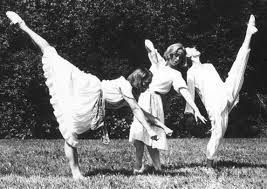
Dance history is a difficult subject to study due to the lack of artifacts left behind to study. Dancing is felt within the mind and body and there is no need for extras. Hunting, for example, is easy to study due to the ample amount of artifacts found, such as arrows, bows, and knives. Therefore, it is not possible to identify when dance actually became part of human culture.
Like cave painting, the first purpose of dance is most likely ritual, appeasing a nature spirit or accompanying a rite of passage.1
Dance is different in each culture and each place around the world. Some dance for God and some dance for intimacy.1
Dancing before the God is an important element in temple ritual, in ancient civilizations. In Egypt, the priest, accompanied by harps and pipes, perform splendid movements which represent significant events in the story of a God.1
In Greek shrines, sacred occasions, such as the games at Olympia from the 8th century BC, are inaugurated with dancing by the temple virgins, performed in a circle in honor of a God.1

In India, formalized hand movements of the priestesses in Hindu temples are described in documents dating back to the 1st century AD. Each precise gesture has a subtle significance and is still practiced by highly skilled practitioners today.1
From rituals to praise, dance is now practiced for exercise, entertainment and competition.
The popular types of dance, now, are contemporary, jazz, tap, ballet and hip hop. Children start dancing in organized classes by the age of three and continue through adulthood.
Contemporary dance is not a specific dance form. It is a collection of techniques developed from modern and postmodern dancing. Jazz dance is also a collection of developed techniques but is very specific. Tap dance is a non-partnered dance form that is choreographed, with one or more participating dancers. A rhythmical tapping sound is made by the dancer from the small metal plates on the dancer's shoes. Ballet is a classical dance form that is characterized by grace and precision of movement. It can be a performed as a partnered dance, or as a solo or group dance. It is generally choreographed and is primarily a performance dance. Hip hop is generated from different forms of dance such as popping, locking and expressing yourself with movement to an upbeat song.2

Dance has come a long way throughout the years and has been developing even further in this century. I feel that dance will keep evolving into something even greater.

References:
1HISTORY OF DANCE. (n.d.). Retrieved September 15, 2016, from http://www.historyworld.net/wrldhis/PlainTextHistories.asp?ParagraphID=ihf

2Summary of Dance Styles. (n.d.). Retrieved September 15, 2016, from http://www.dancecentral.co.uk/DanceNtral/Articles/summary.htm


Use of Drugs in College Athletics: Social Drugs


The most commonly used drugs among student-athletes are social drugs. Social drugs include marijuana, cocaine, spit tobacco, and synthetic marijuana.2 Additionally, alcohol and cigarettes are classified as social drugs but are not banned by the NCAA, with the exception of rifle competition in which alcohol is banned.1 Even though alcohol is not banned by the NCAA, individual institutions can ban alcohol and enforce punishments for the use of alcohol.

Patterns of Social Drug Use by Women's Sports
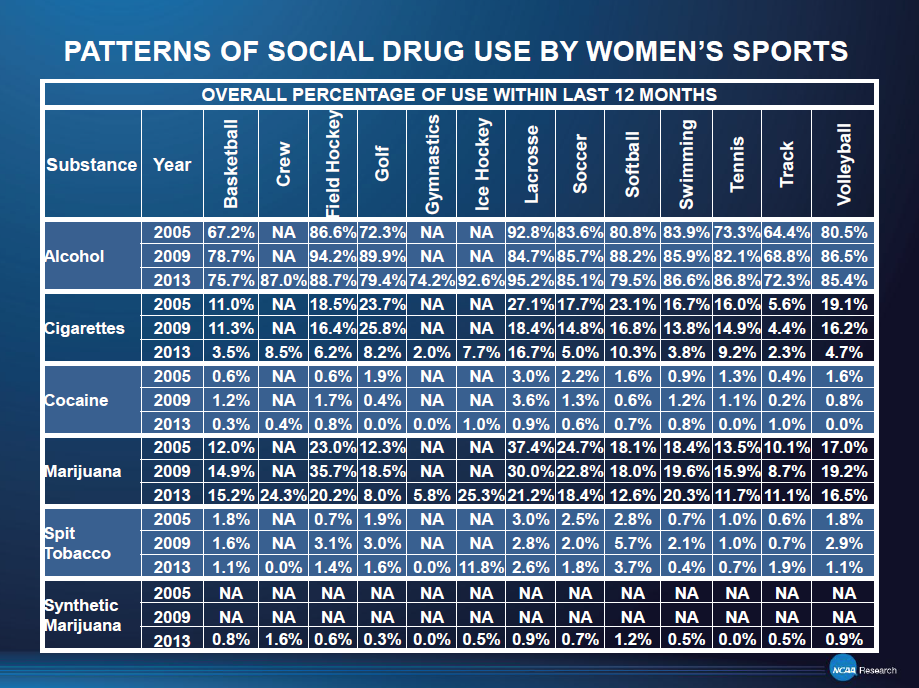
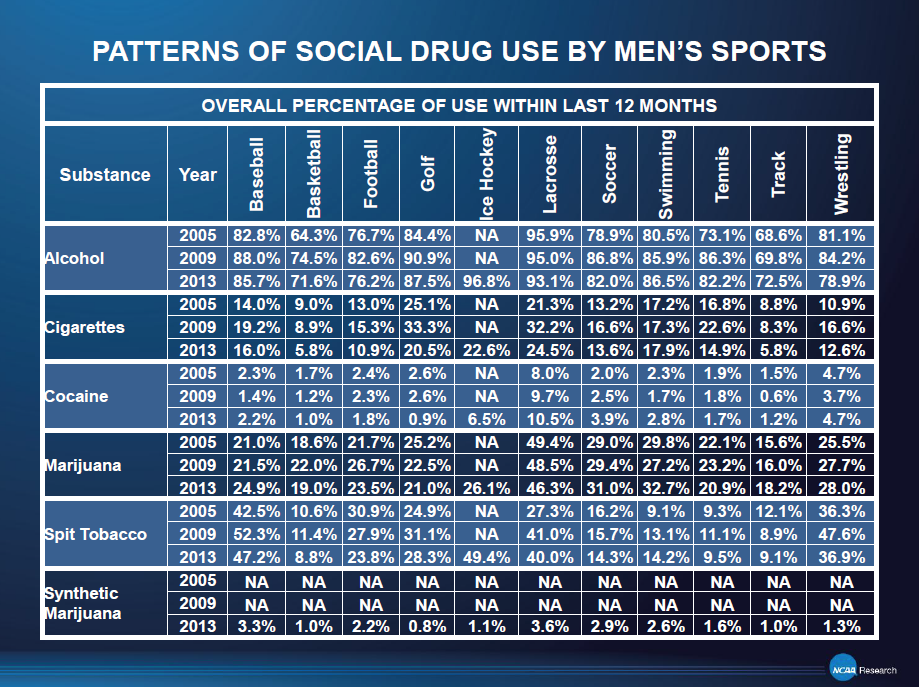
Alcohol is by far the most commonly used social drug by both men’s and women’s sports.2 The other social drugs vary in popularity from men’s sports to women’s sports. Currently among individual sports, lacrosse uses social drugs the most and basketball uses social drugs the least.2 Synthetic marijuana is used the least among men’s sports, but cocaine is used the least among women’s sports.2

When it comes to men’s sports, the use of marijuana has been slowly increasing in soccer, track, and wrestling.2 Soccer, as well as lacrosse, has seen an increase in the use of cocaine; lacrosse and swimming have had an increase in spit tobacco use.2 Additionally, the use of alcohol in swimming and track have been slowly increasing.2

Patterns of Social Drug Use by Men's Sports
Women’s sports have fewer student-athletes that use drugs and also have less widespread use of certain drugs. However, alcohol use has increased in women’s soccer, swimming, tennis, track, and volleyball.2 Marijuana usage has increased in women’s basketball and swimming, and spit tobacco use has increased in women’s track.2

Since 2005, the overall use of social drugs has stayed relatively the same, only fluctuating by a few percent.2 The greatest change in social drug use has been the decrease in cigarette and cocaine use by women, each being used half as much in 2013 as in 2005.2 Men’s sports have not seen significant decreases in social drug use, nor have they seen any significant increase in use.2 Knowledge of drug use patterns can be beneficial to administrative staff and coaching staff as it allows increases and decreases in usage to predict potential drug related problems that may arise in athletic programs. In both men’s and women’s sports, there are fluctuations in usage and historically the most common social drugs continue to be the most commonly used social drugs.2

Next week I will discuss ergogenic drugs and compare the usage of social drugs with ergogenic drugs.

References

1(2012, April 10). NCAA Banned Drug List [PDF document]. Retrieved from http://www.ncaa.com/content/ncaa-banned-drug-list

2Rexroat, M. (2014). NCAA National Study of Substance Use Habits of College Student-Athletes [PDF document]. Retrieved from http://www.ncaa.org/sites/default/file/Substance%20Use%20Final%20Report_FINAL.pdf

An Introduction to the Importance of the Kinetic Chain and Biomechanics in Pitching

www.intl.elsevierhealth.com/journals/jbmt
It is no secret that the best pitchers at the highest level have spent countless hours perfecting their throwing motion. They did not just get on the mound, and start throwing heat effortlessly. However, what some may not know, is that it takes a lot more than training just the upper body to throw a baseball well. When training to be a dominant pitcher, you must take into account that the body and its muscle functions are all part of a kinetic chain. It is also important to recognize that the smallest of biomechanical deviations can affect a pitch. As a result, performance specialists and coaches alike must be sure to take a holistic approach to training and creating the perfect pitcher. Power while pitching is generated in the lower body, transferred through the core, and released through the upper body at the end of a throw. Like Liebenson discusses, muscles stabilize joints like the rigging of a ship, and proper core co-contractions can increase spinal stability by 36-64%1. Imagine the effect this has on a pitcher, when they are properly utilizing the whole kinetic chain vs having a weak core. The pitcher with a strong core, will have more velocity and control over his pitches, compared to one without the equal disposal of a proper transferal of forces throughout the kinetic chain. This concept also goes for pitching with proper biomechanics. For example, when a pitcher is deficient in part of the kinetic chain, over-compensation can occur in a different part of the chain, while trying to create an equal amount of power. This is when injury starts to occur, as Whiteley goes on to analyze in his review.
http://www.jssm.org
As one small example, it is found that pitchers that deviated from the norm of average stride foot placement, and had a more “open foot position” had an extra 2.1N of force generated at the anterior aspect of the shoulder per degree of open foot placement
2. This may not seem like a significant amount of force over the course of one pitch, or even one outing on the mound. However, when a deviation like this is combined with other biomechanical and kinetic chain issues, it adds up, and pitchers find themselves predisposed to injury and at risk of decreased longevity.


References:

1 Liebenson, C. (2007, April 23). A modern approach to abdominal training. Retrieved from www.intl.elsevierhealth.com/journals/jbmt
2Whiteley, R. (2007, March 1). Baseball throwing mechanics as they relate to pathology and performance – A review. Retrieved from http://www.jssm.org


Physical Fitness and the Effect on our Bodies

                                       physical fitness.jpg


The beauty of physical fitness is that an individual is never too young or too old for exercising. The numerous benefits that can be received are astounding. According to the Merriam- Webster Dictionary, physical fitness can be defined as “good health and strength achieved through exercise.”1 Some of these benefits that an individual can receive from practicing good physical fitness is the decreased risk of heart disease, certain cancers (including breast and colon cancer), high blood pressure, and more. It also helps reduce anxiety and depression. Another great benefit of exercising is that is decreases body fat and increases muscle strength. It is recommended to engage in moderate exercising and activities for at least thirty minutes nearly every day.
When an individual exercises, there is a release in the brain of a chemical called serotonin, which is the mood-lifting chemical. Also, endorphins are released which are the painkilling, natural feel-good substances. Not only does physical activity stimulate circulation, but it also brings oxygen and nutrients to the skin. Its builds and strengthens the muscles in the heart, consequently making it pump more effectively reducing the risk for heart disease. Physical activity causes an increase in your heart rate because your muscles need more oxygenated blood. Additionally, it can strengthen your immune system and help fight off sickness. While I have listed many different benefits of exercising, one of the most beneficial things that occurs in the muscles.2 Increased balance and coordination skills occurs, while also strengthening and building muscles. This can help prevent injuries to the bones and joints.
Ultimately, physical fitness is extremely crucial to living a happy, healthy life. Not only are there numerous health benefits, but it truly makes an individual feel better. Paired with proper nutrition and living a healthy lifestyle, individuals will find when they implement exercise into their daily routine they live a happier life.

References:
1Merriam- Webster Dictionary. (1828) Physical fitness. Merriam-Webster Dictionary.
2University of Maryland Medical Center. (n.d.). Exercise. In Depth Patient Education Reports.


What are the Paralympics?

This is the symbol of the Paralympics.
Most people know what the Olympics are, but what are the Paralympics? The Paralympics or Paralympic Games is a major international multi-sport event involving athletes with a range of disabilities; including impaired muscle power, impaired passive range of movement, limb deficiency, leg length difference, short stature, hypertonia, ataxia, athetosis, vision impairment and intellectual impairment.4 Like the Olympics, the Paralympics are in the winter and summer time and take place in the same country and city as the Olympics just a few weeks after the Olympics are over. Usually the Paralympics are not broadcasted on television as much as the Olympics but this year, NBC and some of its networks broadcasted 116 combined hours of the competitions. This is the most time that the Paralympics has been broadcasted in the United States ever.2
At one point, the Paralympics were a part of the Olympics. Athletes with disabilities competed with able bodied athletes.4 The Paralympics became a separate competition from the Olympics in the summer of 1948 in London, United Kingdom. Dr. Ludwig Guttmann wanted to create an elite sports competition for people with disabilities that would be equivalent to the Olympic Games. For the longest time, the Paralympic games were only held in the summer time until 1976. In 1976, the first Winter Paralympic Games were held in Örnsköldsvik, Sweden.4
There are similar sports between the Olympics and Paralympics; archery, canoe/kayak, cycling, equestrian, judo, rowing, sailing, shooting, soccer, swimming, table tennis, track and field, triathlon, curling, skiing and snowboarding are both in the Olympics and Paralympics. Sports that are only in the Paralympics are boccia, goalball, sitting volleyball, sled hockey, powerlifting, wheelchair basketball, wheelchair fencing, wheelchair rugby, and wheelchair tennis.3 In the following blogs I’ll be focusing on, the some of the summer sports (boccia, goalball, paracanoe, paratriathlon, sitting volleyball, soccer 7-a-side, wheelchair fencing, wheelchair rugby, and wheelchair tennis) since this year the Paralympics were hosted in Rio de Janeiro, Brazil from September 7th to September 18th. I’ll be describing how athletes are chosen to do each sport by their disability, as well as, how the game is played and what equipment is used for each sport.

References
1Committee, I. P. (n.d.). Paralympic Logo.

2McFadden, T., Nichols, A., & Ruggiero, A. (n.d.). NBC TV deal monumental for Paralympic         Movement. Retrieved from paralympic.org: https://www.paralympic.org/video/nbc-tv-deal-monumental-paralympic-movement-tatyana-mcfadden-alana-nichols-angela-ruggiero

3USA, T. (2016). Sports. Retrieved from Team USA: http://www.teamusa.org/

4Wikipedia. (2016, September 7). Paralympic Games. Retrieved from Wikipedia.org: https://en.wikipedia.org/wiki/Paralympic_Games