Sunday, September 20, 2015

Adaptive Physical Education Standards

masthead.jpg


At the end of my last blog “The Need to have Adaptive Physical Education in the School Systems”, I ended by giving a brief introduction to APENS. Federal law mandates free and appropriate public education services for all children with disabilities. Subsequently, the law mandated that these services be provided by qualified professionals.Within this law, the definition of special education included the discipline of physical education.(2) In the United States there are only 14 states that have defined an endorsement or certification in adapted physical education. The worst thing is that 36 states don’t recognize nor endorse the certification their teachers need to provide adequate adapted physical education to the students with disabilities.
The sole purpose of APENS is to ensure that physical education is taught to students with disabilities by a certified and qualified teacher of physical education. The APENS devised a set of 15 National Standards that must be met in order to become a qualified adaptive physical education teacher. Along with this APENS established a national certification exam to measure specialized content.
15 National Standards:(1)
  1. Human Development
  2. Motor Behavior
  3. Exercise Science
  4. Measurement and Evaluation
  5. History and Philosophy
  6. UNIQUE ATTRIBUTES OF LEARNERS
  7. CURRICULUM THEORY AND DEVELOPMENT
  8. ASSESSMENT
  9. INSTRUCTIONAL DESIGN AND PLANNING
  10. Teaching
  11. CONSULTATION AND STAFF DEVELOPMENT
  12. STUDENT AND PROGRAM EVALUATION
  13. CONTINUING EDUCATION
  14. Ethics
  15. COMMUNICATION
To see all of the standards in their full description you can acquire the guide Adapted Physical Education National Standards Guide.(3)
The goal of APENS is to promote a nationally certified Adapted Physical Educator (CAPE) – the one qualified person who can make meaningful decisions for children with disabilities in physical education – within every school district in the country.(1)

References

  1. http://www.humankinetics.com/home

Exercising with Multiple Sclerosis

http://tinyurl.com/or4nwo3
Multiple sclerosis is a progressive autoimmune disease and the most common neurological disease diagnosed in young adults. It is believed that multiple sclerosis occurs when the body's own immune system attacks the central nervous system.2 Commonly called MS, the disease generally gets worse with time and can cause significant nerve damage.1 Symptoms are fatigue, weakness, vision problems, gait difficulties, spasticity, and numbness or tingling, ect.   To reverse these effects exercise has been the primary focus during rehabilitation and long-term management.
Exercise is a safe, non-pharmacological treatment strategy for people with MS that can bring many health benefits, including improvements in muscle power, physical and psychosocial functioning and quality of life.3 Remember when deciding on the right exercise program to consider your doctor's recommendations, progression of disease, and your personal fitness level. Exercise is a safe and effective way to heal the body naturally. Progress can be made when sticking to a regular exercise routine.  Exercise is the first step to managing MS pain, so here are a few helpful do's and don'ts for safe exercise.

Safe Exercise Do's:
·         Always warm up and cool down before and after each exercise.
·         Stay hydrated, remember to bring a bottle of water to keep by your side.
·         If balance is an issue stay in reach of a grab-bar or rail.
·         Stop working out if you begin to feel sick or fatigued.
·         Resistance exercises may provide a better starting point than endurance exercises in a heat     sensitive person.1
·         Choose activities you enjoy, exercise should be fun!
·         Set realistic goals.

Safe Exercise Don'ts:
·         Do not get overheated, if these symptoms arise slow down or stop until core body temperature has lowered.
·         Don't overdo it, the body needs time to rest and recover.
·         Don't work out randomly you need a consistent schedule to reap the benefits
·         Don't give up, try taking a friend with you. It is easier to work out when you have a partner to rely on.


References
1Skjerbaek, A., Moller, A., Jensen, E., Vissing, K., Sorensen, H., Nybo, L., . . . Dalgas, U. (2012). Heat sensitive persons with multiple sclerosis are more tolerant to resistance exercise than to endurance exercise. Multiple Sclerosis Journal, 932-940. doi:10.1177/1352458512463765
2Multiple Sclerosis - Symptoms, Causes, Treatments. (2014, June 26). Retrieved September 13, 2015, from http://www.healthgrades.com/conditions/multiple-sclerosis

3Paul, L., Coote, S., Crosbie, J., Dixon, D., Hale, L., Holloway, E., . . . White, L. (2014). Core outcome measures for exercise studies in people with multiple sclerosis: Recommendations from a multidisciplinary consensus meeting. Retrieved September 13, 2016.

Recreational Sports Retention & Recruitment

Campus recreation, a division of student life, is amongst one of the most visited facilities at a university or college each day. High attendance rates are likely so with “almost 30% of the (college) population in the United States are sedentary…”2 Frequently throughout the week, campus tours are given to prospective students wanting to see and learn about a potential university they might attend. Upon approaching and touring the campus recreational facility, many student workers and administrative staff of the building are unaware of the “recruitment pull” the facility can bring to incoming students.

In 2009, a study was done by the National Intramural-Recreation Sports Association (NIRSA) through administration of a Quality and Importance of Services Survey over recruitment and retention that campus recreational sports facilities and programs have. The survey concluded that 60% of males reported that the availability of recreational sports was important when deciding which college to attend. Likewise, the survey also concluded that 68% of the male surveyors responded that campus recreation was important in their decision to continue attending the university.1

Another study in 2006, was issued to a West Texas University to determine why students selected one university over another. Of the 65 students of a possible 4,700 that completed the survey, 27 agreed that campus recreation facilities and services influenced their decision to attend the university.3

Though there are many influences on a student’s decision to attend a particular university, campus recreation does play a part in a fair percentage of recruitment of prospective students. Along with recruitment, studies also show that campus recreation plays an integral role in the retainment of students at a university. As a result, campus recreation facilities and their staff might incorporate recruitment strategies such as in-depth facility tours and handing out brochures to increase student recruitment as well as current student retainment.


1Lindsey, R., Sessoms, E., & Willis, G. (2009). Impact of campus recreational sports       facilities and programs on recruitment and retention among african American      students: A pilot study. Recreational Sports Journal, 33

2Waldron, J. J., & Dieser, R. B. (2010). Perspectives of fitness and health in college men and women. Journal of College Student Development, 51(1), 65-78. Retrieved from http://search.proquest.com/docview/195184098?accountid=7078

3Woosnam, K. M., Dixon, H., & Brookover, R. S. (2006). Influence of campus recreation   facilities on decision to attend a southeastern university: A pilot study.  Recreational Sports Journal, 30

Recovering from Exercise Induced Muscle Soreness


www.pinterest.com
In the Kinesiology world we will come across a particular question at least once in our career,  “What can I do to help my muscle soreness?” In our world we understand this to be DOMS (delayed onset muscle soreness) but in the regular world it is known for “oh my goodness I’m super sore what can I do, NOW?  I personally have been asked this question three times within the last week so I wanted to gather 5 tips to give in the future.  Below are a few tips that can help your clients recover from muscle soreness:

  1. Cool down and stretch properly when finished exercising.1  This particular step is often ignored because we are fatigued and ready to continue on with our day. This one action can actually significantly affect our muscle recovery.
  2. Ice the affected area to slightly reduce the affected area’s temperature to relieve any inflammation or swelling. This icing can be done with an ice pack, a bag of frozen vegetables, or even a full water bottle. Ice the area for 20 minutes with the ice on for 20 minutes off for 20 minutes for appx.an hour to an hour and a half. After icing is complete, be sure to rewarm the area with some gentle massage and light movement.1
  3. Get more sleep.  Multiple studies suggest sleep deprivation can have a significant negative effects on performance and recovery. Sleep is also prime time for the body to undergo protein synthesis, so getting extra zzzs after a tough workout might make for stronger muscles and better endurance.2
  4. blog.anytimefitness.com
    Make foam rolling your friend. Much of the soreness that goes along with exercise occurs when our muscles and fascia-connective tissue running throughout the body become knotted.  Rolling out muscles with foam or semi-rigid rollers can help remove those knots and prevent muscle imbalances from forming.  While not exactly noted for its comfort, the benefits are worth it.2
  5. Take a bath in Epsom salt. This is a personal benefit that has extremely helped with my recovery from exercise.

When it comes to a healthy lifestyle, your recovery days and easy workout days are just as important as the days you crush it. Take the time you need to rest, and reap the benefits later.


References
  1. Borreli, Lizette. (2013, Aug. 20). Post Workout Soreness: Expert Tips On How To Relieve Exercise Induced Muscle Aches. Retrieved September 13, 2015 from http://www.medicaldaily.com/post-workout-muscle-soreness-expert-tips-how-relieve-exercise-induced-muscle-aches-252969.
  2. Tao, David. (2015, Aug. 11). Speed Recovery: 17 Scientifically Proven Ways to Speed Recovery. Retrieved September 13, 2015 from www.greatist.com.

Sport Specific Weight Training

Bodybuilders are known for using weight training to get big and strong. One idea would be using the same workout program to excel in their sport, but this isn’t so. Athletes should use a weight training program specific to their sport. “Sport specific training is simply fitness and performance training designed specifically for athletic performance enhancement.”1. The idea behind sport specific weight training is to train the body in a way that is a natural movement to the sport. “Unlike bodybuilding, where the only aim is to increase the size and appearance of muscles, strength training programs for sport ultimately must develop either explosive power or muscular endurance.”2. 

The first thing an athlete needs to think about when weight training is the specific muscles that are largely used when interacting in the sport. For instance, pitchers for baseball mostly use their upper body and core to succeed in their sport. Most of their movements involve balance and arm strength. They typically don’t bat, so they wouldn’t need any special lower body workouts. The recommended weights are any type of ab workout, bench, incline, kettlebell toss, and bicep/tricep curls. For kickers/punters in football, they would mostly work out their core and lower body. Most of their movements involve balance and leg strength. The recommended weights are any type of ab workout, squats, calf raises, lunges, and box jumps. The last example would be defensive lineman in football. Most of their movements involve every muscle in their body. They require balance, leg strength, arm strength, and core strength. Due to every muscle in their body being needed for their specific position in the sport, their weight training needs to include days where they just focus on the lower body and the next day focusing on the upper body. Each day can have some form of ab workout, but separate lower and upper body workouts. Each position in each sport will require a different workout because each position requires different movements.  


1.SPORTS SPECIFIC TRAINING: WHAT DOES IT MEAN?
Published on the website http://www.finishfirstsports.com/sports-specific-training.html by Coach J.  Hoy, CSCS

2.The Sport Specific Approach to Strength Training Programs
Published on the websitehttp://www.sport-fitness-advisor.com/strengthtrainingprograms.html

Patellar Tendinitis in Volleyball Players

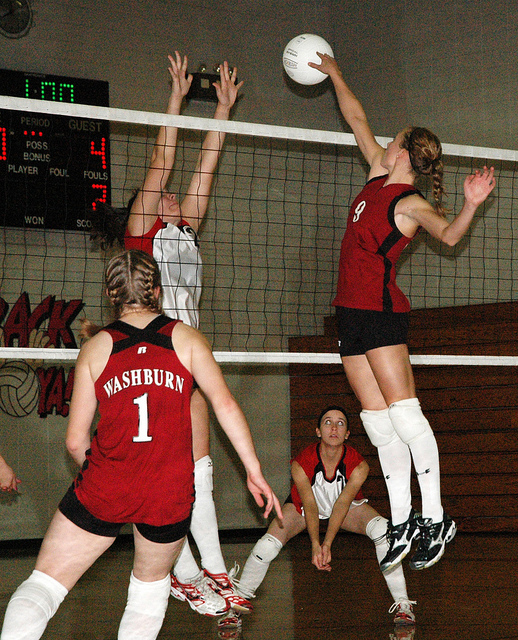
Imagine yourself in the stands at a collegiate volleyball game watching the athletes prepare and warm up for the game they are about to play. They go through a series of warm-up drills to activate and engage every muscle so that their bodies are fully prepared to meet the demands this sport requires. Proper warm-up techniques and stretching programs help prevent injuries that may occur during a sport which stresses every joint in the body, such as volleyball.
As you watch the game, you notice how much the outside hitters have to engage their leg muscles to jump to an adequate height to create the kill they strive for. You also take notice of the libero who has to be low and in control of her legs to get down far enough to get the dig she wants. All positions in volleyball require strong and stable leg muscles to be able to withstand the load that is continuously stressed on the knee joint. Unfortunately injuries do occur pretty frequently in volleyball players; the most common knee injuries are tendinitis/tendinosis issues, meniscus tears, and ligamentous damage.
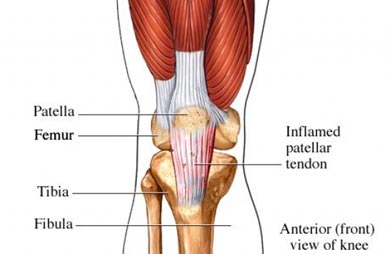
In this particular blog, we are going to focus on tendinitis issues in the knee. In the next few weeks we will discuss meniscus tears and ligament damage, respectively. Patellar tendinitis is inflammation or irritation of the tendon that connects the kneecap, also known as the patella, to the tibia.1 The most common ways of irritating that tendon and causing inflammation, also known as swelling, is by repetitive jumping.1 In the sport of volleyball the most common jumping would come from going up to block or by jumping to spike the ball.1 These types of motions create immense amount of stress on the knee joint therefore allowing tendinitis to set in quite easily.
It is much easier said than done to decrease the amount of jumping that a volleyball player must do within a game, let alone in practice. Therefore, the most beneficial treatment of patellar tendinitis will come from consistent and proper rehabilitation of the tendon.2 During resistance exercises of the quadriceps muscles which form into the patellar tendon, the biggest improvement of this injury was scene during the eccentric motion of the knee.2 Eccentric means to “work the negative” or provide a slow controlled movement of the weight away from the body.2 An example of an eccentric workout for the patellar tendon would be leg presses; the athlete is seated with their knees and hips at 90 degree angles with their feet against a weighted board that can be pushed away while they concentrate on a slow controlled movement backwards.2
In conclusion, when dealing with patellar tendinitis patients, the best route to relieve pain and get them back on track is to strengthen upper and lower leg muscles surrounding the knee.
References:

Tuesday, September 15, 2015

Choosing the Right Running Shoe

Image from Wikimedia
Running is an awesome sport that all ages can enjoy regardless of their fitness level or access to athletic facilities.   It is also a simple sport to pick up in the fact that the only equipment needed is a pair of shoes and ground to run on.  However, many people avoid running, walking, or jogging due to issues such as back pain or knee pain that can be linked to not using the proper shoe that their feet require.  They may also find themselves with other injuries related to over-pronation or supination such as Achilles tendonitis, arch pain, rigid big toe, hip pain, iliotibial band syndrome and plantar fasciitis.1, 2
The first thing someone should do when picking the right running shoe is to find out how their feet move and what they do when striking the ground. A person's feet will exhibit characteristics of a natural movement, an over-pronation, or a supination movement.3
  • During natural movement the foot exhibits pronation with the foot rolling inward and the arch of the foot flattening.  Some pronation and flattening of the arch is normal and those with a natural movement usually have less running related injuries.3


  • During over-pronation the foot rolls too far in with the foot arch collapsing and providing no support for the body.  Individuals that exhibit over-pronation usually have flat feet or very low arches.3


  • Supination is when the foot rolls outward instead of inwards and is very poor in absorbing the shock during a run. Individuals that exhibit supination usually have very high or ridged foot arches.3
Shoe manufacturers design and manufacture shoes to accommodate those that have a natural, over-pronation, and a supination foot movement.  So, once you find out your foot movement type you should pick a proper shoe that accommodates your need. Those with a natural movement or supination movement should pick a neutral shoe which characteristics are that of soft midsoles, the shoes can be easily twisted, and are overall very flexible. Those with over-pronation should look for shoes that offer support which can come of different degrees of midsole densities, shoe curve and flexibility.  Those with extreme over-pronation should look for shoes designed to be motion control shoes.3
Next time you are in the market for a new pair of running shoes, take this information with you so you can make a better purchase and have a more enjoyable running experience.


Sources


1Are Your Shoes Causing Your Back Pain? (2015) Beth Israel Deaconess Medical Center. Retrieved August 30, 2015, from

2Can Shoes Cause Knee Pain? (2015). Livestrong. Retrieved August 30, 2015, from

3Selecting the right shoe for you. (n.d.). Running Warehouse. Retrieved August 30, 2015 from

Images from

Rhabdomyolysis and It's Threat to CrossFit

Since the founding of CrossFit, Inc. in 2000, CrossFit has become a widely recognizable and vastly popular sport among today’s exercise enthusiasts. Simply by watching the athletes participate in the CrossFit Games, it’s easy to see the allure of the sport; strong, fast, and conditioned bodies. However, with all the benefits to the human body that CrossFit has, it can bring just as much harm as well. With the growth of CrossFit, comes the emergence of rhabdomyolysis.
What is rhabdomyolysis?
  • Rhabdomyolysis, or “rhabdo” for short, is a condition caused by injury to skeletal muscles resulting in the breaking down of the muscle, leading to the release of proteins, such as myoglobin, into the bloodstream. Once in the bloodstream, the proteins travel to the kidneys, where the kidneys cannot filter out the proteins, resulting in kidney failure.1
Why is CrossFit at fault?
  • The type of rhabdo associated with CrossFit is termed “Acute Exertional Rhabdomyolysis”, which is brought on by the overuse of a muscle or muscle group, without allowing the muscle time to recover and repair itself. Due to CrossFit’s mantra of pushing the body to its limits, and then push more, a condition such as rhabdo, which is normally a rare occurrence in any activity (including athletics), becomes more commonplace and a legitimate threat to the athletes. In other sports, such as football or rugby, the body is given time to recuperate after a workout. Even Olympic lifting provides enough time for rest. CrossFit promotes a constant wear-and-tear on the body, causing rhabdomyolysis to be an issue.1
Signs and Symptoms of Rhabdomyolysis
  • Initially, rhabdo will present much like DOMS (delayed onset muscle soreness). As time goes on, the soreness will turn into a severe pain.
  • Muscle weakness
  • Dark, tea-colored urine
  • Extreme amount of swelling in affected areas2
http://www.healthcareatoz.com/wp-content/uploads/2013/04/Muscle-Tear1.jpgBefore CrossFit hit the scene, rhabdo was a rare coincidence outside of military training. Now that CrossFit has become more popular, rhabdomyolysis is becoming more and more of a household name. This isn’t to say rhabdo is guaranteed with CrossFit, many people will never show signs or symptoms,2 but due to the mindset and culture associated with CrossFit, there is the potential for kidney failure, and possibly even death.

References:
1 Muscal, Eyal. "Rhabdomyolysis." : Practice Essentials, Background, Pathophysiology. Ed. Lawrence Jung. Medscape, 22 June 2015. Web. 02 Sept. 2015.

2 Hallam, Liam. "The Rise of Exertional Rhabdomyolysis in Crossfit, Running and Endurance Sports." <i>Hubpages.com</i>. Hubpages.com, 28 Feb. 2015. Web.