Sunday, February 28, 2016

How Do Vitamins Benefit You?

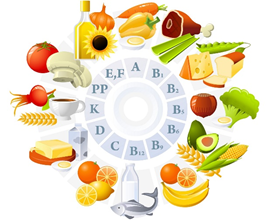
Vitamins are organic substances which  are essential to proper nutrition. They are found in most animals and in certain plants. They act as coenzymes and precursors in the regulation of metabolic processes, they do not provide energy or serve as building units.. There are 4 essential vitamins that are very important for the body. These vitamins  promote a healthier life and changes throughout the body.
·       Vitamin D is a major factor in regulating metabolism, taming hunger cravings, and boosting your immune system. It comes at no surprise to see more sniffles in the cold, winter months when we are bundled away from the Vitamin-D-giving sun. For an immunity boost, show some skin! Multiple studies demonstrate the association between increased vitamin D intake and a reduced risk for colorectal, skin, breast, and prostate cancers. With the help of calcium and magnesium, vitamin D also improves bone development and cardiovascular health. Foods that containing  Vitamin-D are herring, salmon, halibut, cod liver oil, catfish, mackerel, oysters, sardines, tuna, shrimp, eggs, and mushrooms.1
·       Magnesium is another bone builder that about 56% of Americans lack. Magnesium maintains blood circulation, supports cardiovascular health, and helps  muscles and nerves relax. Foods containing  magnesium are nuts, swiss chard, dark leafy greens, sunflower seeds, dark chocolate, squash, pumpkin, cucumbers, black beans, navy beans, cereals, and bran.1
·       Omega-3 Fatty Acids have been in the nutrition spotlight due to their amazing health properties. Fatty acids are the building blocks of fats, which are vital nutrients. These mighty omegas curb inflammation, regulate blood clotting, build cell membranes, and support cell health. Omega-3 is a polyunsaturated fat, which contributes to peak cardiovascular health by reducing blood triglycerides and LDL cholesterol. Because the body doesn’t produce omega-3’s, it is essential that we obtain it from our diets. Foods that have omega-3 are salmon, tuna, sardines, and mackerel, walnuts, flaxseeds, hemp seeds, wild rice, omega-3 fortified dairy products, and omega-3 enriched eggs.1
·       VITAMIN A is very healthy for the eyes and general growth and development. Vitamin A also assists with healthy teeth and skin. Foods that contain Vitamin A are carrots and other orange foods including sweet potato and cantaloupe melons – all of which get their hue from the carotene pigment.2


References:

15 Essential Vitamins and the Foods You'll Get Them From. (n.d.). Retrieved February 21, 2016, from http://blog.doctoroz.com/oz-experts/5-essential-vitamins-and-the-foods-youll-get-them-from
211 Essential Vitamins and Minerals Your Body Needs [LIST] - Goodnet. (n.d.). Retrieved February 21, 2016, from http://www.goodnet.org/articles/11-essential-vitamins-minerals-your-body-needs#



Screening Principles


Screen, pick, drag. Whatever name it goes by, it has become an effective asset to any successful offense. Anyone who has any familiarity with the game of basketball understands the basic concept. A screen or "pick" occurs when an offensive player attempts to block, or "screen", a defensive player away from the man he is guarding, thereby freeing up that offensive player for an open shot or pass.1 The principle of this is simple. However, learning to execute a screen properly, and effectively, is something that can be a little more difficult. To be effective in executing a play involving a screen there are several rules that the screener, receiver, and passer all need to be aware of. 
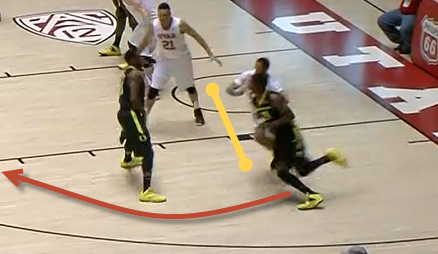
Screen-Shot-2013-02-05-at-3.56.39-PM.pngThe screener must start by being able to see the ball, allowing them to properly time the placement of the screen. Once arriving at the defender, they must widely plant their feet and lower their body position, providing a solid stance to obstruct the defender. When doing this, the screener must pay special attention to the angle at which they set the screen. The screeners back should be facing the direction the player receiving the screen will be cutting. If the screener’s angle is too flat, the defense will be able to quickly recover to a good defensive position. After the screen has been used, it is the screener’s job to quickly put themselves in a position the receive a pass.2 Some coaches prefer the screener to pivot facing the ball, opening themselves up to the pass and also possibly shielding a defender who may try to go underneath the screen. Others may prefer the screener to turn and sprint towards the basket, creating as much space between themselves and the player being screened as possible. This helps to open up the floor and limit the amount of a help that the defender guarding the screener can give.


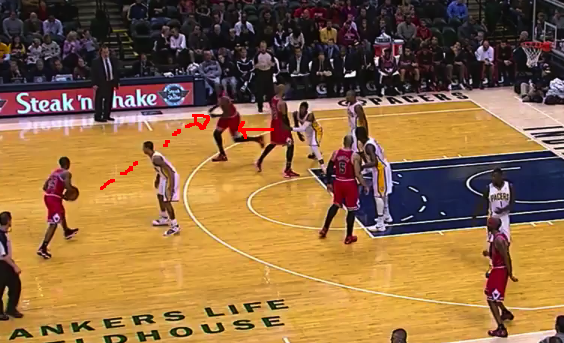
down-screen2 (1).png The player receiving the screen must stay stationary or move in a way to help the screener until they are in position. Once the screener has arrived, it is the player receiving the screen’s responsibility to set their defender up and use the screen effectively. To do this they must make sure they are as close to the screener as possible when coming off of the screen, allowing no space for the defender to go between them. It is also the player’s responsibility to read the reaction of their defender and how they are playing the screen. This will help the offensive player know what cut to make to create the best shot.
If the screen is happening away from the ball, the passer also has a set of rules to follow. It is their responsibility to see the entire floor, particularly the screener. They must be able to read and react to the way the defenders play the screen and anticipate an offensive player coming open. If you wait for the moment when you see the player open, then it will most likely be too late to make the pass, especially at high levels of competition. The pass made must be a good, crisp pass, away from the defense, that puts the offensive player in the best position to score.2
All three components of the play; the screener, the player receiving the screen, and the passer, have a set of rules or principles to guide them through the play. With the implementation of these principles, the chances for an open shot should increase. As with any offense, the players abilities to read and react to the defense and each other can help their success. However, knowing these screening principles will go a long way to increasing your team’s basketball IQ.

References

1Gels, J. A. (n.d.). Basketball Fundamentals - Setting Screens, Coach's Clipboard Basketball Coaching and Playbook. Retrieved February 22, 2016, from http://www.coachesclipboard.net/Screens.html

2Gandolfi, G. (2009). NBA coaches playbook: Techniques, tactics, and teaching points. Champaign, IL: Human Kinetics

3Oregon Basketball Analysis: These Screens Will Set You Free. (2014). Retrieved February 22, 2016, from http://fishduck.com/2014/01/oregon-basketball-analysis-these-screens-will-set-you-free/

4“AND-1!”: A Breakdown Of How Tom Thibodeau Gets Carlos Boozer His Favourite Look. (2013). Retrieved February 22, 2016, from http://pippenainteasy.com/2013/02/05/and-1-a-breakdown-of-how-tom-thibodeau-gets-carlos-boozer-his-favourite-look


Daily Drills Pt. II


       Not only should offensive linemen do drills which work  on balance, foot speed, and flexibility, they should also work on drills which  will improve blocking techniques in the run and pass games. Like the drills stated in my previous blog, these drills are meant for off-season, summer workout,  or in season pre-practice warm-up and they  can be done in 15 minute sessions daily. I strongly encourage these drills be a staple when working the technique aspect of offensive line play as they can definitely give you the competitive edge needed to win football games!

  1. Board Drills - Board drills are an excellent way to work on footwork for run and pass blocking techniques.1 Boards are a great way to establish good angles which  linemen need to take when they are blocking. They are a great way to develop the proper first step an offensive lineman needs to take because without a good first step there is no second step. Another alternative way to do board drills is to have another player on the opposite side of the board to simulate a defensive lineman and teach blocking angles and leverage.
  2. Med Ball Punch - Offensive Linemen need to have strong hands because they are our only weapons. This drill can be used to develop strong hands, hand eye coordination, and can teach aiming points and timing to strike the opponent. Med ball punches can be used to teach both run and pass game situations
  3. Pass Sets on Air -Speaking from experience and currently coaching, there are offensive linemen who have never been  coached on how to pass set properly because they played in more run - focused style of offense. Pass sets on air are a great way to teach novices the finer techniques of pass protection in a closed and stable environment.2
References:
1Fun Football Blocking Drills - The Board Drill - Football Tutorials. (2009). Retrieved February 26, 2016, from http://www.football-tutorials.com/fun-football-blocking-drills-the-board-drill/492/
2Football Offensive Line: Pass Blocking. (n.d.). Retrieved February 26, 2016, from      http://www.playsportstv.com/football/football-offensive-line_pass-blocking

Air It Out

The last couple of weeks we have discussed a new definition for the turnover, and avoiding punting and kicking-off deep as a way to help score more points.  But at the end of the day you need an offense to score.  Without an effective offensive game plan, it will be difficult to score points. In previous post I mentioned that Sid Gillman was the father of modern football.  Gillman based his offensive principles around a vertical passing game that utilized a single running back, and passing to set up the run.  Coaches including Don Coryell, Bill Walsh, and Mouse Davis all used Gillman’s principles to influence offensive football.

Coryell became famous in the 1970’s as the head coach of the San Diego Chargers.  During his time there he created an offense that used multiple wideouts, motion, and numerous route options on any given play.1  His offense, which became known as “Air Coryell,” took Gillman’s “Pro-Set” and evolved it to take advantage of the NFL rules at the time.  Next, would come Walsh’s “West Coast” offense.  Walsh devised an offensive system that used the pass to replace the run, focused on short, quick passes, and used multiple receivers.2  Walsh again took Gillman’s “Pro-Set” basics and adjusted them to exploit NFL defenses in the 1980’s.  Finally, we have Mouse Davis and the “Run and Shoot.”  The “Run and Shoot” became popular in the late 1980’s and early 1990’s.  The “Run and Shoot”  uses four wideouts, single running back, and requires for the wideouts to adjust their routes based on the defense’s coverage.3  The Warren Moon-led Houston Oilers are the best example of a “Run and Shoot” team.  They famously didn’t even have a tight end or fullback on their roster on several occasions during the 90’s. From Gillman to Coryell to Walsh to Davis, the passing game has evolved into a deadly, efficient tool for football coaches over the years.

Today, many of the principles from Gillman, Coryell, Walsh, and Davis are still in use.  Perhaps, the most well known pass-first offense today is the “Air Raid.”  The “Air Raid,”  at it’s core, is just a modern interpretation of Gillman’s “Pro-Set.”  While Hal Mumme and Mike Leach get most of the credit for the “Air Raid,” LaVell Edwards, former head coach at BYU, created the principles that form the foundation of this offense.  Edwards took Gillman’s ideas and integrated them into an offense that featured four wideouts, a single running back, and sought to take advantage of zone defenses by having receivers run different routes at different depths on the field.4  Mumme and Leach took Edward’s ideas and went crazy with them.  The result of their outside-the-box thinking was a passing offense that would shatter the record books.  The “Air Raid” also made it possible for schools like Texas Tech, that couldn’t get the quality of recruits that bigger schools could, to be competitive.  The “Air Raid” has permeated all levels of football from high school to the NFL.  


As coaches continue to scheme and plan in hopes of finding the golden ticket that will allow them to crush their opponents, we continue to see the influence of Sid Gillman.  Fifty years after he created his “Pro-Set,” it is still the grandfather of modern offensive football.  It is an exciting time to be a coach and fan of football.


References
1Air Coryell Offense Definition - Sporting Charts. (n.d.). Retrieved February 21, 2016, from http://www.sportingcharts.com/dictionary/nfl/air-coryell-offense.aspx
2WEST COAST OFFENSE OVERVIEW. (n.d.). Retrieved February 21, 2016, from http://www.westcoastoffense.com/overview.htm
3Run and Shoot Definition - Sporting Charts. (n.d.). Retrieved February 21, 2016, from http://www.sportingcharts.com/dictionary/nfl/run-and-shoot.aspx
4The Air Raid Offense: History, Evolution, Weirdness – From Mumme to Leach to Franklin to Holgorsen and Beyond. (n.d.). Retrieved February 21, 2016, from http://smartfootball.com/offense/the-air-raid-offense-history-evolution-weirdness-from-mumme-to-leach-to-franklin-to-holgorsen-and-beyond#sthash.2CK72LPd.dpbs

Competition is an Installment in the Circuitry of Human Nature

http://tinyurl.com/zy9o2xv
Competition is an installment in the circuitry of human nature. It drives the race to greater heights and pushes the survival of human existence. Thus, as a pragmatic fact, individuals will separate themselves accordingly. There will be those who reach the greatest of heights and those who miss the opportunities to do so. Let readers not be mistaken, we do not  live in a world where everyone is given the golden star. This blog will intend to address this theme of, competition, as the sports world prepares for the competitive push into this next month and college basketball’s March Madness.


“Selection Sunday is the day when the NCAA men's and women's basketball committees determine which teams have made the field for the  year's basketball championships. Selection Sunday in 2016 will be on Sunday, March 13th”.1 The indication that there is a selection process speaks volumes into the direction of this very conversation. Selection Sunday can very well be interpreted as ‘Separation Sunday’.


http://tinyurl.com/buq7j58
There are three phases to the process to determine the 68 teams for the tournament:
I. Select the 36 best at-large teams;
II. Seed the field of 68 teams; and
III. Place the teams into the championship bracket.


SELECT, SEED, PLACE…are you beginning to catch on? In sport, very much like the real world, we are measured against one another. Regulations take place in the fairest measurement possible; who’s the best and so on. The interesting aspect in regards to this year’s tournament will be who exactly emerges to the top. Currently, for the sixth time this season, college basketball has a new No. 1.2 With such heavy competition, this year’s tournament has fans anguishing in anticipation. A tournament which will surely bring forth the best of all its competitors; with at the end, only one team able to step forth as a champion.
March Madness, we welcome you.


1NCAA.com (2016, February 21). Selection Sunday 2016: When it is, what it is, and everything else you need to know. Retrieved February 21, 2016, from http://www.ncaa.com/news/basketball-men/article/2016-02-21/selection-sunday-2016-when-it-what-it-and-everything-else-you

2O'Donnell, R. (2016, February 08). NCAA basketball rankings 2016: Villanova is your new No. 1. Retrieved February 21, 2016, from http://www.sbnation.com/college-basketball/2016/2/8/10937770/college-basketball-rankings-2016-ap-coaches-top-25-poll-villanova


Nutrition for Athletes on the Road

Nutrition for Athletes on the Road

For a rodeo athlete from the beginning of February to the end of October, they are traveling cross country to compete in as many rodeos as possible to qualify for the National Final Rodeo (NFR) in Las Vegas in December. Some drive, while others fly, fly but regardless of their means of transportation they go ninety to nothing. So how do these athletes keep themselves conditioned and energized on such a tight schedule? In reality, most rodeo athletes do not consume the foods they need to stay ready to perform at the elite level. There are a few who eat nutritious foods that fuels their performances which is the reason why these select few are the best of the best. Today, there needs to be more concern for these athletes to eat nutritiously in order to perform their best; not simply just eat to eat. It would be unrealistic for most of these athletes to prepare all their own food yet, I would like to provide a guide to show them how to eat to fuel their bodies properly on the road. Healthy eating starts where you stop. If you're on the road and stop at a fast-food joint, your food choices will be limited to fast food. But if you stop at a grocery store that offers whole or healthy foods—fruits, bagged carrots, nuts, hummus—or a supermarket that features a salad bar, you quickly expand your choices (and reduce junk-food temptations).1  Eat frequently, and in smaller amounts. Eating small amounts of healthy foods throughout the day sends a signal to your brain that the food supply is plentiful, so it's okay to burn through those calories quickly. Limiting your calorie load at a single sitting also gives you lots of energy.1 Eating plenty of complete proteins will also be needed to keep your strength up. Avoid foods that make you feel bloated or uncomfortable as these will having feeling sluggish and not at 100%. Last and final tip is to drink lots of water! Drinking plenty of water will flush your body of toxins, keep your skin fresh, and help you eat less. It will also help you avoid travel lag, symptoms of overexposure to the heat or sun, and junk-food cravings.
6 Tips for Eating Healthy on the Road1:
1.      Healthy eating starts where you stop
2.      Eating frequently and in small amounts
3.      Eat plenty of protein
4.      Pack snacks so you’re not skipping meals
5.      Avoid foods that make you feel sluggish
6.      Drink plenty of water
  1. 6 Tips for Eating Healthy on the Road. (n.d.). Retrieved February 28, 2016, from http://www.mensfitness.com/nutrition/what-to-eat/6-tips-for-eating-healthy-on-the-road


Tuf Cooper, Shane Hanchey, and Trevor Brazile in the jet on their way to St Paul Rodeo. Tuf tweeted this pic. Follow him at @tufcooper:

Saturday, February 27, 2016

Plyometrics Part 1: Starting from the Ground Up, Literally!

In my previous blog (Click here!), we discussed and briefly outlined the topic of plyometrics, and their importance to any training regimen. Plyometrics are an amazing additive to any training regimen, (IF, the big IF), they are done correctly. With that being said, I will begin at square one with plyometrics... metaphorically and literally. What is “square one” for plyometrics? In the mind of a coach it’s simple: I must ask myself, How can I teach you to jump higher, farther, and more explosively, if you don’t know how to control yourself when you get back down to the ground. Thus,the position  that is more vital to understanding in this blog is: The Power Position.
Why the “Power Position?”
The power position is my go-to teaching tool before I EVER tell an athlete to perform any high-impact/jump training. Why? Well as stated, I won’t send someone soaring through the air, if I don’t have faith they can land safely, and most importantly, land under control. This is crucial as  a good amount of lower extremity injuries occur from non-contact incidents. That leads me to believe, as a strength and conditioning professional, that athletes are not in proper muscular balance or under the needed body control to compete at high levels safely.
What the “Power Position” Looks Like
The power position is best described by example. Seeing as I can’t physically show you, here are a few examples with explanations of what you should and shouldn’t do when working on you landing or power position. The picture on the left depicts a very good power position. The term power position comes from the fact that most high-power, high-velocity movements, (whether it be a chest pass, jump, or beginning a sprint), can begin in the power position. Take notice of the athlete’s feet: they are flat on the ground, weight is in the mid-foot (not on the toes or heels). This is right where you want it to be. The athlete’s orientation of his entire body position as a whole is vertical and off-set; his shoulders are slightly forward, his hips slightly backward. This creates balance in the landing position. The next step involves  being able to identify what you DON’T want when performing the plyometric landing. Notice the picture on below, how the athletes knees are caving in, and this is before they have even jumped! This is called valgus knee, which is characterized by the lower extremity such as foot being placed or pushed outside the body, creating a look that appears the knees to “cave in.” Poor landing mechanics + poor jumping mechanics + right circumstance = injury... plain and simple. If you do notice your knees coming in when working on your landings, there is a simple mental cue to remember: spread the floor. By doing this, you will push through your feet, attempting to spread the floor, but most importantly will get the glutes working and will naturally pull the knees back out into a natural alignment.
How to implement/utilize the Power Position Landing into your Training
Implementing the plyometric landing drill is actually quite simple: simply add it in the beginning of your workout after you have warmed up. With my collegiate athletes, no matter if they are a senior or transfer or a freshman, we work on landings for the first 3 weeks. We begin at 5 sets of 3 reps as we  increase higher boxes from week to week. We begin at 12”, then progress to 18” and then 24”, as long as the athlete has displayed proper control and mechanics throughout the training progression.
Wrap-Up
Plyometrics are a vital piece to the puzzle when considering athletic development, whether it be yourself, a client, or an athlete. Remember  to start from the ground up, literally! Help clients and athletes build a solid foundation for future plyometric training by practicing the plyometric landing. Once you have mastered this through the course of 3-4 weeks, then (and only then) will you be ready to take flight and start some actual plyometric jumping! Be sure to check back next week for Part 2 of our plyometric training series. Until then, safe landings, and happy lifting.
References
1Baechle, T.R. & Earle, R.W. (2008). Essentials of Strength Training and Conditioning (3rd ed.). Champaign: Human Kinetics.
2Kish, R. (n.d.). Proper Plyometrics: How to Box Jump, Vertical Jump, and Broad Jump Correctly. Retrieved February 21, 2016, from www.breakingmuscle.com website: http://breakingmuscle.com/strength-conditioning/proper-plyometrics-how-to-box-jump-vertical-jump-and-broad-jump-correctly
3McQuilkin, T. (2014, August 14). Plyometric Training: Landing. Retrieved February 21, 2016, from www.powerathletehq.com website: http://powerathletehq.com/2014/08/14/plyometric-training-landing/